Monday, 27 April 2015

MAKING Propositions

Quite a lot has happened over the last few weeks, and I feel my practice is finally starting to gain some movement and rhythm.

After spending quite a lot of time thinking, I decided that during the Easter break I would ban myself from my laptop and note book...and give myself one whole week of making. No words allowed (ish).

I sat at my bench with the samples I had made already; and like I had done earlier in the unit with my found objects, I interrogated them. I choose particular samples that I liked the most and tried to identify to myself why I liked them. Was it the form? The size? The notion of function? I then took each sample and recreated variations of it; I asked ‘what if?’ questions like, “what if it couldn’t sit flat on the table?” or “what if I combined elements of two samples?” this helped me to identify and acknowledge functions and details that I really liked within the samples.


After a visiting The Whitworth as part of my professional platforms unit, I was inspired by their ethos and the new brand they are promoting. All the work exhibited in the gallery and products for sale in the shop are carefully selected to represent pioneering, playful and intelligent practitioners. I have tried to reflect this attitude in my own work, bringing a light-hearted approach to my experimentations, not worrying or overthinking things and just ‘doing’.

As well as “what if?” questions, I decided to isolate samples I liked the most, and created their families, for example, the samples skinny Aunty, its fat Uncle or its Siamese twin cousins. I found this new way of sample making extremely fruitful, it allowed me to very quickly create a lot of variations, not worrying about what it’s going to be. At this point in the project, I am not concerned with making samples that are directly obvious as jewellery; I am purely concentrating on shapes, forms and the visual communication they portray.


Because of my newfound interest in the language of objects and the way colour, materials and form can influence a person’s perception of something, I went and bought lots a brightly coloured yarn, some colourful false nails and nail varnish, charity shop blue & white china, and some water clear resin. I started to experiment with setting the different everyday materials in the resin, first simply in some ice cube trays. I liked the way that the water clear resin seemed to intensify and light up the colour of the objects trapped inside. I also made some simple tube settings and used glass lenses for bases, a simple but effective way to act as a carrier for the resin. I like the combination of the brass with the resin; it immediately created ‘jewellery’ like appearance to the samples.


After making quite a lot of samples, I lay them together on a plain sheet of paper; I could see clear patterns had started to form, I could identify my favourites, and decide which aesthetics I thought were successful and which weren’t. It helped me to know where to go next, or should I say what to make next!


I really like the contrast of the solid, smooth metal and the free flowing thread; I also like how using thread, textiles and yarn has allowed me to easily experiment with an endless variety of colours, and how textiles have a very close historical relationship with domesticity and women.

While I have been spending a lot of time in my studio making, I have noticed how I seem to be most intrigued and attracted to the everyday, practical elements of creating. For example, the circle of cereal box cardboard I made and used to create hand made rope, the strips of masking tape used to measure out rings that I stick in my notebook for future reference, or the way the sticky tape labels are wrapped around each length of tube, identifying its width and thickness. I have also started to really like the photographs I take of my samples in situ; where they were made, on the wooden, scratched and burnt bench, amongst the tools that created them. This is something I need to further question in my practice...what is it about these things that I am attracted to? How does using and holding them make me feel? Is it about doing? About movement or relationships? I'm not exactly sure yet, but this is what I need to underpin and find out in order for me to feel like I have grounding and clarity in my practice. 


 “The true secret of happiness lies in taking a genuine interest in all the details of daily life” 
William Morris

Wednesday, 18 March 2015

Creative Mentoring

I am currently on a short course to learn the basics on how to become a creative mentor. I have been learning some invaluable skills that will allow me to teach a wide range of people from children, to folks with disabilities. I always saw myself teaching in a more conventional way, in a college or university, but this programme has shown me new possibilities that I could get involved with.

I like the idea of teaching one off workshops or perhaps a small series of workshops, and through Market Place Studios (where I am a tenant), I opportunities like this will be a regular occurrence. I’ve been looking into other practitioners and places that run workshops for the public, there are several in the Manchester area, it seems there has been a real revival of craft and the handmade. In this ever growing 'computer screen' lead world, people are enjoying going back to basics and learning how to use their hands - my Mum is a member of the WI who often have craft nights, where they get local makers in to run classes. Although my specialism is jewellery, I’d be quite happy to run general art and design workshops, encouraging people to get in the creative spirit.


To get a first bit of experience with something like this, I arranged a ‘Crafternoon for Comic Relief’ in the pub where I work. I taught a small group of locals to make crochet red noses (some made blue noses!). Even though it was only a very small and informal session, it really confirmed to me that this is something I can see myself doing in the future. I found it really enjoyable showing the people what they needed to do, helping anyone who was struggling to achieve the correct technique. I’ve already got lots of ideas for potential workshop ideas, and I’m really looking forward to when I can have another go at running one!


Professional Platforms

The Professional Platforms unit is great opportunity to push my practice and myself into the ‘real world’, through a practical project, research context, work experience and general interactions with an external partner. The unit runs from now until the end of the MA and we were given several projects to choose from. The project I have chosen to take part in is a teaching experience - Unit X, run for the BA students. Having always wanted to teach once I finish my own education, I thought it would be the perfect chance to discover the ins and outs of teaching at HE level. Also, as a past student that has taken part in Unit X for the last three years, I have a definite level of understanding from a student perspective and I am familiar with how the unit is run.

The specific course I am involved with is called Whitworth Limited Editions, aimed a students who are interested in becoming self-employed, working to create products in response to particular client and audience. After meeting up with course leaders Cj O’Neill and Sally Morfill we discussed where I would be able to help out and what my responsibilities would be...in a nutshell I am acting as a general teaching assistant or ‘extra pair of hands’ and I would also be required to document activities for the Unit X blog. I am really happy to have found a project that I will genuinely be able to learn a lot from, not only teaching and workshop management techniques but also gaining an insight into how units and projects are put together.

I have had a fairly heavy involvement with the introductory week; following an introductory lecture to the brief, the students began with a hands-on, drawing and making session. The aim of the day was to get them generating a range of ideas for potential project starting points, encouraging them to work is cross discipline groups, utilising each other’s different specialisms and skills.

At first I was a little worried about the amount of students we were working with in one space - 70! However once we got the group sat down in tables of 8 it was a lot less intimidating, wandering round asking how they were getting on and what they thought of the brief. I found it really unusual and interesting, as I still remember so clearly being in the same position a couple of years ago, I think its sometimes nice as a student to talk to someone who isn’t a tutor, and is a similar age, yet can give you first hand advice that isn’t patronising.


 In their allocated groups, the students began the creative process by constructing a list of words; five words that related to The Whitworth and five action words that related to a material, such as tear, weave or fold. From these words, they produced a series of timed two and three-dimensional drawings using a wide range of found materials provided. The next phase was to start thinking in a more product, problem-solving way. In groups of 4 or 5, the students were asked to design a container for an item of food; they had to select and assemble the materials that should be utilised, then without making it, develop a set of instructions to visually explain how to make this container.


It was great to see how the tutors adjusted the session as a result of the students reactions to each task; there was a basic plan of the day that all staff had received prior to the launch, but we found that when the students were asked to work alone, the room was very quiet, then once they were working in pairs or small groups, the noise level raised, they were conversing...so from then on, the students only worked in groups. Small adjustments like this made the day much more creatively rich as the students were loosening up and enjoying themselves. Showing that even though a plan has been made, it can always be adapted, allowing the session benefit all involved.

After the day I was asked to write a post for the Unit Xblog, I included a brief summary of the day and some photographs I had taken during the session. I made sure that during the day I made lots of notes and took plenty of photographs to help me remember what had happened. Some of the final containers that the students had made were really interesting and exciting; I kind of wished I were sat there with them doing the task myself!

The next and very important session I helped with was the introduction to the Whitworth, including a guided tour around all that the gallery offers; the two shops, the work exhibited in the gallery, the collections and the surrounding park. It was my first visit since the building had been refurbished, and although the place isn’t quite complete, I was really impressed. All the guides were clear to state that the new brand they are trying to create is based on playful, personal and intelligent work. Everything presented in the gallery and shops has been meticulously considered, right down to the fixtures and fittings.


During the day, again, I acted as a general assistant. Making sure that all the students were in the correct groups and knew where they had to be for each section of the day. I also documented as much as I could, taking photographs and making notes - I could only stay for half the day as I had other MA commitments in the afternoon. I could tell the students really enjoyed the day, there was so much information given to them, I’m sure they had lots of information buzzing around in their heads about potential ideas for their projects. I’m looking forward to the peer/post-it review next week to see how their thoughts are materialising. 

Cornelia Parker 'Cold Dark Matter: An Exploded View'

Tuesday, 17 March 2015

Intentions to Propositions


The feedback I received following the Design Intentions unit was really helpful for me to find clarity within my own practice. When I’m exploring, reading and making it is so easy get bogged down with a mountain of paper and samples, resulting in overlooking patterns that are naturally forming in my research; you can force your practice in a way that you think it should be heading, rather than allowing the research to naturally lead you in new directions you perhaps aren’t used to.

The narrative of women’s issues have always been a really important element of my practice, however I found in the last unit I was forcing the idea...avoiding certain books or readings if I didn’t think they linked with my themes. I also started to find it difficult to explain to people where I stood in the argument. Was I against the expectations put on women? Was I empowering women? Was I making unfair judgements on stereotypes of modern women compared to women of the 1940’s, 50’s and 60’s?


The topic of female issues is riddled with negativity and I need to clarify exactly what it is I am trying to say through my work, what is my narrative and how can I make it current and relatable for the women of today that I am aiming my jewellery at? I enjoy looking at vintage photographs of women and things that can traditionally be linked with women; floral patterns, hourglass figures and feminine pastimes such as embroidery or knitting. The idea of practicality vs. presentation inspires me, the way modern women can juggle so many different roles and necessities within their lives. I don’t like to call myself a feminist, as with that title comes a lot of pessimism and disapproval, I have always researched feminist issues simply because it interests me, not because I am a man hater or I burn my bra at the weekends. I don’t think women should be treated differently to men, I think they should have the same opportunities and expectations; equally I think that men should be able to partake in seemingly ‘female’ activities such as being a stay at home parent or watch rom-com films without appearing unusual or ‘un-manly’. Challenging that though, I also think that it’s perfectly ok for women and men to be different...because hey, guess what? We are different!

I think I am using my jewellery to celebrate women...embracing the modern woman and her various identities. A national campaign by Sport England that has personally motivated me recently, is This Girl Can, “It's a celebration of active women up and down the country who are doing their thing no matter how well they do it, how they look or even how red their face gets.”. The campaign encourages women to fight against judgement.. I want to find more modern stories to tell within my work and perhaps use real women’s stories to help me build a clearer message.

This Girl Can campaign poster

But in the mean time...
I have always felt a strong attraction to objects, in specific everyday, domestic objects; it became obvious to me in the Objects and Context unit that this was something I wanted to concentrate on and explore more deeply in my work. The Language of Things by Deyan Sudjic and The System of Objects by Jean Baudrillard have had a huge impact on my thinking and ambitions, and my tutorial with Helen reassured me that it is ok to put certain aspects of your practice to the side (like the feminine issues) to allow to you explore other areas, guiding your research in new directions. Perhaps a few weeks down the line I will come back, full circle to feminine issues through the domestic, utilitarian objects I am investigating.

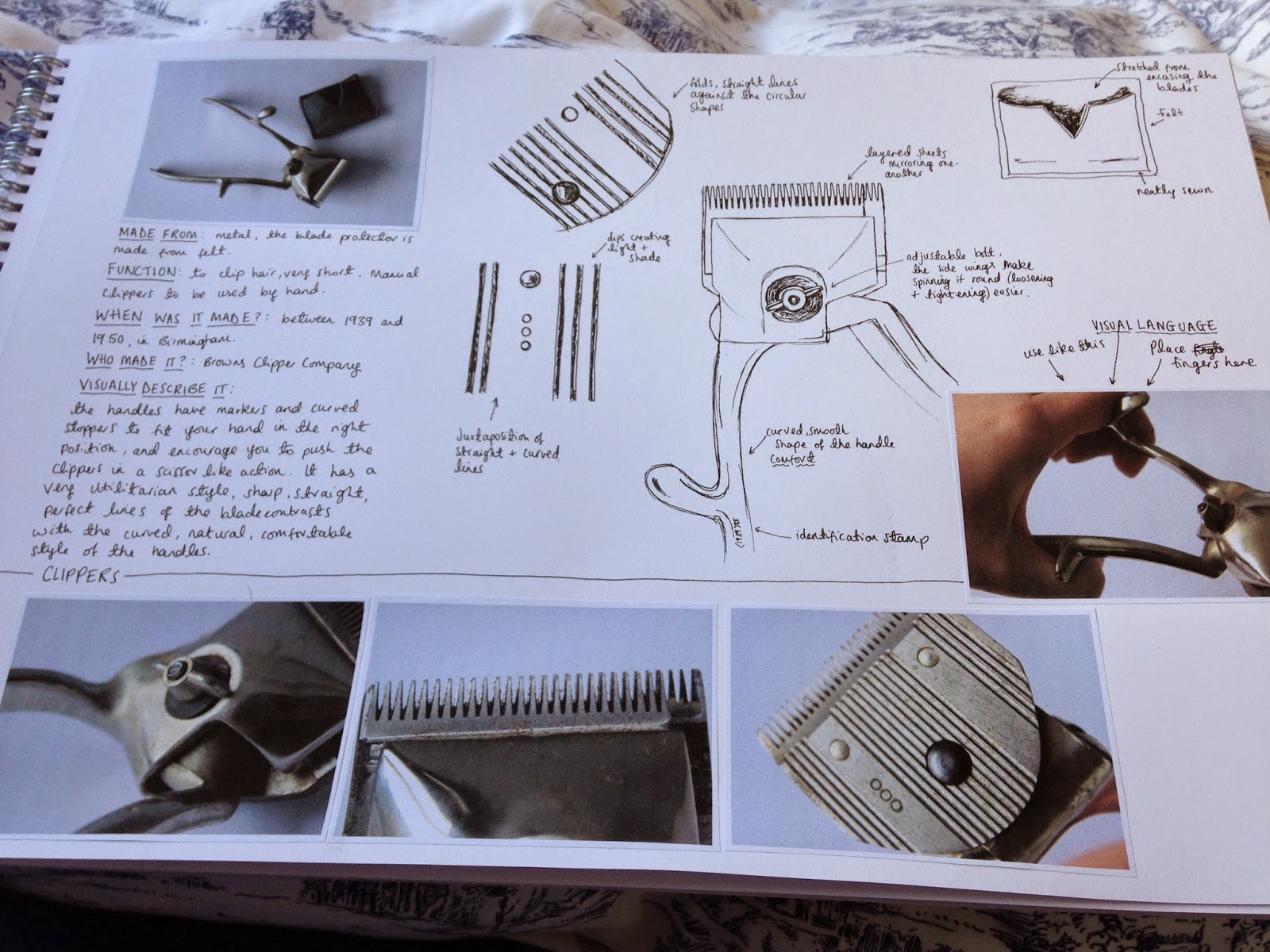
I decided to make a list of things that I wanted to achieve by the end of the next unit (Design Propositions), finding and highlighting simple ways of moving my practice forward, taking a few risks to solve the questions still unanswered in the last unit (Design Intentions). To begin, I took a very straightforward, object lead approach; I gathered together objects I have collected over the years and interrogated them. What did I like about them? How were they made? What was their function? Who would use them? Did they relate to each other in some way? The interrogation consisted of photographing and drawing each object, and then visually describing it, I also photographed the objects grouped into categories to help me create relationships between each one, acknowledging similarities and patterns through the collection.


Some of the objects I have interrogated.
An example of a page from my object interrogation sketchbook.

Experimenting with different materials, isolating parts of an object, and reinterpreting its physical qualities.

I wanted to identify, on a material level, ways I could visually react to specific elements of each object. In the past I have always shied away from using new, different materials, this is going to be one of my main risk taking strategies in this unit. In The System of Objects Jean Baudrillard talks about the use of colour and material variations to create atmosphere, how colour can create a language understood by all. “’Loud’ colours are meant to strike the eye. If you wear a red suit, you are more than naked - you become a pure object with no inward reality. The fact that women’s tailored suits tend to be in bright colours is a reflection of the social status of women as objects.” (p.31) We have relationships with colours and materials embedded within us through cultural, mental and experiential structures; wood for example is “so sought after today for nostalgic reasons. Wood draws its substance from the earth, it lives and breathes...time is embedded in its very fibres...In short, it is a material that has being” (p.37). I want to experiment with the effect of combining different materials with metal to help create this visual language. I’ve made a list of materials and techniques I want to try, to introduce different colours and materials into my work.

More often than not, the part of an object I find the most interesting and appealing is the part that makes it functional; hinges, clips and clasps, things that invite you to hold, use and interact with it. In The Language of Things, Deyan Sudjic talks about archetypes in design; for example, a gun is traditionally a symbol of power and masculinity, yet notions of the trigger can be found in so many domesticated objects such as a hoover handle or oil can. Generating the same sensation but with none of the risk. I like the thought of creating notions of interaction; mimicking mechanisms from a domestic object, to create wearable and cherished jewellery...same sensation, none of the context.


As well as an object’s physical language, Sudjic also talks about luxury. Comparing why we value certain objects differently depending on what they are made from and how they are made, how ‘serviceable’ they are or the gratification the user derives from it’s contemplation as an object of beauty. He states that if an object is seen as expensive, or costly in the time it took to make, it is more likely to be seen as beautiful and consequently, luxurious. If an object is luxurious, the user is more likely to gain a sense of enjoyment, satisfaction and even indulgence from owning and using it. Again, this is something I am going to investigate further in my practice - jewellery is so easily designed as a luxury item, I want to challenge this by creating jewellery perhaps made from less conventional materials, physically inspired by objects not commonly seen as opulent.

To make things happen, I have been making regular ‘to do’ lists; I started by writing a list of things I wanted to achieve by the end of the project, then working backwards, things I needed to do to accomplish these goals. I now make a weekly and a daily to do list, it seems extravagant, but it really helps me to get work done. Simple, small, achievable steps make each day feel as productive as possible.