Thursday, 13 November 2014

Observing


I started observing my own personal 'random acts'; I've noticed that I like to hang things. I am quite an organised person and I find comfort in when objects and my possessions are in their place. However in reality, at first glance, my room often doesn't look especially neat and tidy...I do admit this is quite a contradiction! I have realised that for me, organising my stuff isn't a case of everything being tidy, its about grouping objects together and knowing where everything is.

I have a series of hooks made for hanging jewellery on, (top pics) yet I regularly find myself hanging an assortment of different objects on it to make them seem more controlled. I also use the hooks to hold letters or paper that I need to remember to take places.

The pictures below the hooks is an example of my 'as long as its in something its okay' philosophy. I have a rather small basket that I put clothes in that I wear to the farm (where I keep my horse), the basket is right near the door, so the clothes (which often can be a bit smelly!) feel very separated from my clothes in my wardrobe. The basket is far too small for the amount of clothes I keep in it, but I continue to pile them up on top of each other...I don't know why I don't just find a larger basket or sort out the clothes in a more efficient way, but while the clothes are concentrated in and on the basket, this isn't something I feel I need to worry about.

Finally the bottom picture is two items of clothing, hanging outside the wardrobe. I tend to do this when I buy new clothes, I don't really know why...

Material Matters


Materiality is a huge part of our culture; the Material Matters exhibition in the Special Collections allows you to experience objects stripped of their 'story'. We are so accustomed to viewing objects in a museum alongside descriptions and explanations of their history...so being able to view artefacts and interpret them purely from your observations and personal knowledge is an unusual privilege. Seeing the array of different qualities one material type has, depending on where, when or how it has been created is fascinating.

We talked about material facilities and the practicality of using certain materials, why use mahogany rather than MDF? Why does one material have a higher value than another? Of course there is the physical qualities of materials...strength, appearance, ease of manipulation or availability. Makers have a close connection with different materials, and create their own opinions and decisions about which materials they prefer to work with. Being a jeweller, I have experienced working with many different metals and I certainly have my favourites. You create an understanding of which metal will work the best for different jobs, for example, working in brass is certainly a lot more labour intensive than working in silver or gold. Advertising and media encourage us to treasure some materials more than others; diamonds are a marketing success, we are told they are valuable so we pay a lot for them.

Despite Stephanie (the curator of the exhibition) being very keen to state that the objects in the exhibition were displayed with no context, I don't think this is possible. Nothing comes without context, the mere fact that the objects are in an exhibition is context in itself. How does an object qualify to be collected and put into a museum? We cherish the history of these objects but who decides that it has enough history? Why has that particular object been taken out of the real working world and been made into an artefact? The preservation of these objects is curious to me, we don't seem to trust or value the changes the last 30 years have on things. To me, it seems a shame to stop an object from developing further history by placing it in a glass cabinet or even worse (in my eyes) a plastic bag or box in storage!


Wednesday, 12 November 2014

Design Intentions

Design Intentions is all about embracing this new way of MA thinking in my own personal practice. During my BA, I really enjoyed the research side of my practice, but I always tended to use secondary research to help inspire my designs; things like statistics or facts about women and feminist issues. I always felt a struggle to visualise how I wanted to transform my thoughts and beliefs into pieces of jewellery, meaning I was never completely satisfied with my outcomes. It was almost like the ideas ended up being more important to me than the finished piece. This is something I need to concentrate and improve on in my MA, I want my research to be honest and meaningful. I am going to start this by talking to real women, and perhaps in some cases real men, and find out their true stories and opinions on feminist ideals. 

After talking to my Nana, it has started to become clear to me that the feminists that I have spent an awful lot of time researching (like the suffragettes, Emmeline and Christabel Pankhurst) were of a completely different class to those like my Nana; who had to work to support their family, as the husbands wage alone wasn't enough...the idea that different women were affected by feminism in different ways depending on their race, class, age is very interesting to me...was being an active feminist a luxury for the higher classes?!


My Nana  - Wynn Taylor
During a seminar we were introduced to the watchword technique, a way to help find words that encourage a deeper reflection of our practice. Words are very useful to help to explain and express what you are doing, describing your activity. I find that while your in education, especially when coming to the end of a BA, you find yourself using the same words and the same sentences to help you describe your work. Even more so perhaps, when you finish Uni; having to fill in application forms and write endless artists statements. It's a good idea to sit down and really think about the words you are using...are they successfully describing what you do? 

When filling in the form, I began with the words I am so used to using in reflection of my work; women, metal, form, domestic, wearability...it was when I started to find words that connected each of these that I started to reveal new words that I wasn't used to using. The three words I ended up with were 'intimate', 'cherished' and 'possessions'...now these aren't words I would immediately use. However when thinking more deeply about my practice, I do address topics about women - and in some ways - their insecurities, this is a very intimate thing. Objects are a big influence, in specific useful, domestic objects that may well have been cherished in use. Possessions could link to these objects, but it could also link to the beliefs that we possess on feminist issues. As a big fan of words and writing, I really enjoyed the process, and I intend to fill in another form perhaps at the end of the MA, to see how things may (or may not) have changed.


Introducing a theoretical grounding to my work...

Creatives often use their practice as a form of therapy, a voice to express their personal values and opinions; I have started to consider where exactly it is that I see myself and my practice in society and the world...where do I fit in? 


Being introduced to theories on design has opened my mind to a whole new level of thinking. Understanding your field, the context in which you work and acknowledging communities you may be part of help you to create a framework and structure for your practice. We have multiple ways of being and seeing the world, multiple ways of being one identity...we change our identity according to context. The way in which we learn and experience things plays a big part in how we produce ideas and designs. The act of transforming these thoughts, ideas and experiences into physical objects is something that seems so obvious when talking about how designs materialise, yet I have never taken the time to think about it in more detail and in the context of jewellery. 

We are becoming increasingly familiar with the idea of jewellery being more than just decoration, I find myself describing my jewellery as a 'vehicle for for social commentary' but what does this really mean? I subconsciously pass on my thoughts and beliefs into my research and consequently into my designs and final pieces. Jewellery is emotional and is socially connected with human life and culture, it is personal and portable, and it is this bodily contact that makes jewellery a perfect way to humanise social issues that affect us all. 


My work is a reflection of my personality, but it is also a reflection of my learning. I produce my own meanings by elaborating on pre-existing subjects that I agree with or find inspiring, making a constant regeneration of ideas and opinions.

Pioneer of contemporary jewellery, Ted Noten's jewellery is not about beauty, it's about a message and a connection between the wearer and the ornament, "I make jewellery that takes some time getting used to. When you wear it, you make yourself vulnerable as it makes such a striking statement. I speak out through my jewellery and objects. I comment upon jewellery as a phenomenon, upon the industry or - like any artist - upon humanity". 

Jewellery has the undeniable ability to reflect the beliefs and personalities of both the maker and the wearer, and it is this fact that I am becoming increasingly interested in. I want to explore the connection the jeweller may have with the wearer, and the importance of jewellery to be left in a state where personal stories can be imparted onto it....


Monday, 3 November 2014

Anticipating Change, Round Two

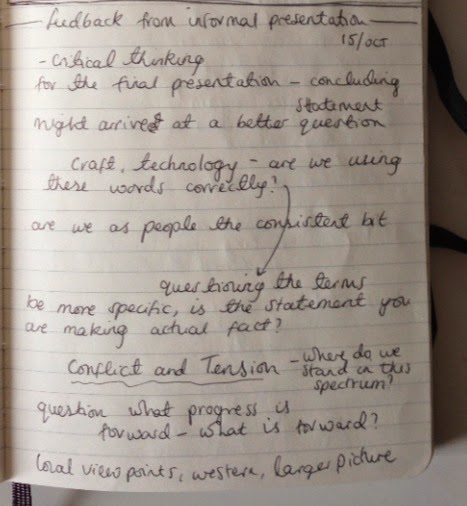
The general feedback from the informal presentations was to...make sure that we were thinking critically about our subject, using the presentation to lead to a concluding statement or question; making sure there is a level of coherency within the presentation, to get through all the relevant research in such a short space time and finally, to be careful of use of terminology and avoid sweeping statements. Because the feedback was general to all of the groups, it was quite difficult to be sure which points were directed at us, so we just decided to take all the comments on board to help us progress our project.


After a meeting with the full group of deciding how we are going to tackle our final presentation, we found ourselves having to make some compromises due to time constraints. It seemed foolish to abandon our Prezi after spending such a long time putting it together and after seeing how easy it had made our delivery. We decided that to make our research more critical, reflecting our groups individual thoughts and beliefs, we would round our presentation off with a debate...the human vs. the robot. To make it more personal, the illustrators in the group created visual interpretations of both sides of the argument, humanising and personalising the computerised Prezi.


Coming home to this months issue of Crafts magazine was a happy coincidence...it's focus was on the future of design and makers at the forefront of future thinking - shame it didn't arrive 3 weeks ago! When reading the articles inside, I felt I was reading with different eyes. This project and MA have already had an impact on my thoughts and opinions...I would usually have skipped the pages revolving around the digital and advances in the 'computer world', however now I am really interested in the designers themselves, and the reason why they use digital technology in their work. One of the designers in the review on Make:Shift, was Gregory Epps creator of RoboFold, he embraces both hand made and new age techniques in his metal sculptures, 'his tools range from biros and craft knives to industrial robots and a lot of rather complex computer software'. He believes that "objects are more successful when they begin in the real world"...finding out designers who use the digital technologies in their work who have similar beliefs to Gregory Epps brings me a sense of comfort. How could a designer go straight from an idea to creating it on a computer screen to production without the middle testing/sampling/trial and error stage? For me, missing out that middle phase would be like ripping the creative and fun part out of designing...


"Will making things by hand be using a mouse on a computer?"
This was said by someone from one of the other presentations, and it really encouraged me to wonder whether digital technologies are going to take over the future of design...I don't think so, new and innovative technologies like RoboFold allow makers to create work that may not have been possible without machines, however I don't think there will ever be a time when the handmade will become redundant...

It had started to become clear to me that the future of design is being able to find a comfortable, appropriate convergence of traditional and technology? Craft can utilise any tool, hand or machine. The machine has always been perceived as replacing the hand of the maker (since industrial revolution), but craft has not disappeared. New tools or old tools, it’s the thinking of the person behind the tool that counts...David Hockney said when questioned about his use of iPad technology for painting “Well, a paint brush is also technology you know!" 

Again, we had a bit of a struggle with balancing the wants and needs of the part timers, with the practicality of the full timers putting together a coherent presentation. We (the full timers) sat down and collated our research into 'sides', we had such a lot of research it took quite some time to sieve out the most significant parts...we divided the next stage of the project between the group, Christine and I were working on the arguments we wanted to make, Jo and Allen were busy making sketches for the Prezi and James the 'Prezi king' had the job of putting all the text and images together for the presentation.

POST PRESENTATION...

The presentation itself went really well and again the preparation of the Prezi made the delivery clear and concise, allowing us to add a bit of character and humour to the argument. The reaction from the audience was great and they laughed at all the right bits! 
We kept our title as 'Computers as the Creator?' and made valuable arguments for both sides, but it was clear by the end of the process that it wasn't possible for computers to be independently creative, however digital technologies and traditional craft were no longer two separate things, the future of design was the two working together. No matter what the future may hold, it seems to me that one rule won’t change: a good craftsperson should use whatever tool is best for the job. 

Objects & Context


We have been introduced to our Options unit now...and for me, choosing one was easy. I love objects and the stories behind them, so the Objects and Context was clearly the option for me.

In the first session we were introduced to Parallel Universes: Making Do and Getting By + Thoughtless Acts (Mapping the quotidian from two perspectives) By Kevin Henry. The article is about industrial design researcher Jane Fulton and sculptor Richard Wentworth, and how they use photography to better understand their environments and the people who inhabit them. The images show unintentional human involvement with objects, from a wellington boot propping a door open to a bottle top being used as a ash tray. We were asked to go out and observe the world around us and create our own collection of photographic documents...when you are given a task like this, you find yourself walking through the city (or wherever you may be walking!) constantly looking, trying to find objects that have been used by humans in this inadvertent way...it certainly makes my commute more interesting!

 "These images are small portable pieces of the world viewable any time after the event."
- Kevin Henry


Why do we classify, why do we collect and why do we value objects? These are questions that I am extremely inspired by. In my own work, I am visually inspired by utilitarian, domestic, everyday objects; narratively, I am inspired by traditional and modern female roles and feminist issues. I like to make playful relationships between my story and these simplistic objects. There are a lot of jewellery designers that make social comments within their work, however in general, the jewellery created is extravagant and unwearable, more like gallery pieces. During my MA, I want to find a way to create jewellery that is wearable, yet still tells a story. There is something very beautiful about an object that only just does what it is suppose to do, the simplicity and perfection in use of materials and form.

Objects are life's stage props...

Objects have a history and they have memories, an object that is old and worn shows that it has been used, loved and valued. We can learn a lot about an object by looking at these wear and tear marks, we can discover how it has been used, handled and interacted with. When we see marks on an object that indicate how it might have been held, we are encouraged to hold the object in that way too. By doing this we feel a connection with the past, this human interaction is comforting and something you would never achieve with a new, mass produced object.


Kintsugi is a Japanese tradition of celebrating broken ceramics by repairing them with gold. The belief that if an object (in Kintsugi's case, a ceramic object) is worn and damaged, it is of greater value because it has been used, and the fact that it has been broken should be embraced rather than disguised. The repair itself adds value to the object, becoming part of its history. There is something very special about an object that has been repaired, especially if your the person that has repaired it. If you have an object at home that you have personally fixed, it begins to mean more to you as you have had an impact on its life, you feel a connection with it.

Despite this, it all depends of context...if you were to buy a jug directly from the potter, you would inspect it and you may find glaze splatters on the base and perhaps a finger or thumb print indented in the clays surface, these things (well for me anyway) would be an added bonus to the fact the piece was handmade...the small imperfections making the piece feel more authentic. However, if you were to go to John Lewis and buy a similar style ceramic jug, but mass produced; when you get home and discover a thumb print or a blemish, you may take it back and ask for a new one!


Here are some of the photos that I have been taking...


Friday, 24 October 2014

Anticipating Change..


I think its about time I started talking about our first project! 

We were set a short group project to get us in the swing of things. The project is part of the first unit, Design Intentions and asked us to "identify, analyse and present the next key influences for design in terms of Craft, Materiality and Technology and to explore these through, the Senses, Collaboration and Play". 

Our group included both part and full time students, all from different disciplines, this meant that we could all bring our own individual knowledge and personalities to the project. Being the only member of the group that has come onto the MA straight from my degree, I found it interesting to see how everyone else was very concerned with the brief and what they thought the tutors wanted as an end product from us...and for me, this wasn't really a worry at all. Coming from a interdisciplinary BA course like Three Dimensional Design, I am used to being presented with a very open project brief and having to adapt it to your own work, using research to guide you in a direction that you may not have at first thought about.

We decided the best strategy was to divide the areas of interest (craft, materiality, technology, senses, collaboration and play) between us and research each generally, without a specific direction in mind. After this individual research, we could then come together with our findings and take things from there.

I was keen to take on 'craft'...as a maker; craft is something I am very passionate about. I researched how craft fits into the design world and how sometimes, the actual word 'craft' is a confused one. To me, the most important aspects from my research were that craft is growing and becoming more desirable to consumers; in this ever growing technical world, people like to have original and personal handmade things. The human contact being paramount. The individual skill of the craftsperson adds value to a piece, more so than an object made by a computerised machine or through mass production.


When we met again as a group to discuss our discoveries (the part time students contributed their research via email) it was clear that each area linked with at least one of the others. For me it seemed that the main link was the human contact...new materials being created to react to the human body, designers creating objects that stimulate not only sight, but all our senses, technology simulating human skills, artists using play to allow people to feel involved with their work and collaborative projects bringing designers and their skills to create new and innovative work. We then started to wonder whether design would be accessible and engaging to people without this human contact...and whether it could actually be possible for machines to work creatively without human input?


We seemed to be steering down a very technical themed route, and for me this proved a big challenge. I felt that as the only devoted maker in the group, the project was heading in a direction that I am not knowledgable and comfortable in. In many ways this was a positive thing, as I was getting the chance to learn about an area that I had never concentrated on before...however as things became more and more detailed, (we spent a whole day discussing AI, which before this project, I hadn't a clue what meant!) I began to feel more and more uncomfortable and disengaged with the theme. We came up with a working title of 'AI as the creator'...this was something that as a maker, who is passionate about the handmade and our personal interaction with objects, was a troublesome task. 

I decided to try and find some makers that have embraced the technical world within their craft. Michael Eden was a perfect example. After spending over 20 years of his life being a traditional potter, he decided to embrace technical advances in the design world. He strives to create a link between aspects of the handmade that people love so much, with new innovative digital technologies, creating meaningful objects that relate to both the actual and the virtual world. 

A Rebours - Michael Eden
http://www.edenceramics.co.uk/product6.html


Eden's work challenges traditional views that using machines is a case of 'pressing buttons' with instant gratification, some of his pieces take hundreds of hours to create on the computer. He often works between the computer and the potters wheel, allowing him to get a better feel of form and size in ceramic samples, before committing to anything on screen.

Despite this enthusiasm and openness to using digital technology in his work, Michael Eden is clear to remind people that computers are not a quick fix way for people to become creatives; they can only produce interesting a meaningful work, when combined with a innovative, creative and experienced mind...

"After this exploration of how traditional and digital tools can be creatively brought together, I came to the conclusion that they are only tools and that there has to be a reason for using them, whether it be a desire to explore, an idea to communicate or a problem to solve." - Michael Eden

We discovered drawing robots, one specific example being Paul, created by artist Patrick Tresset. Paul creates portraits by using a webcam to scan a persons face, then using a robotic hand he translates the scan onto paper using a biro pen. But is Paul being creative? It was interesting to see that in general, the only types of drawing robots weren't actually being used to create or design anything of use or importance. To me, it all seemed a bit of a gimmick.

Paul - Patrick Tresset
https://dl.dropboxusercontent.com/u/18451154/book_tresset.pdf    

We adapted our working title to 'Computers as the Creator?', I was keen to add the question mark, as from my research it had become clear to me that no, despite robots like Paul, they aren't actually being independently creative. Any computer that is seen as being creative, has been programmed by a human to be so, and without the human, would not function 'creatively'.


We decided to use Prezi for our informal presentation, this is a online software that I hadn't used before, but it was really effective. It was clear that spending such a lot of time configuring the Prezi presentation was time worth spent...despite only having the time to run through the presentation as a group once (then loosing our two part-timers to a library induction!) I think that because of the clarity of the visual presentation, the progress of our project and the direction it had taken was clear for others to understand. We even talked about our use of Prezi to create the presentation, we were using the software to transform our ideas and discussions into readable form. This lead me to think that technology, when used appropriately, can assist a designer or maker to express their ideas to others in an understandable way. In a similar way that I am using this blog to concentrate and condense my note book scribbles.


A quote that I particularly liked said by Geoffrey Mann, "its when you give technology soul, that you start to do something interesting with it". This quote has had a large impact on our project idea, and we have decided to adapt our working title of 'Computers as the Creator?' to thinking much more deeply about creativity itself, and whether it can be taught, and in turn how will this effect the future of design....stay tuned!

Some useful links that have been helpful in the research process...

http://www.wipo.int/wipo_magazine/en/2013/02/article_0004.html 
'3D printing and the future of stuff' the potential for customers to be involved in designing and producing objects for themselves.

Digital technologies being embraced in craft.

Using digital technologies to simulate human error.

This was of particular interest for me, using digital technology to attempt to mimic the connection a wearer feels when wearing a personal piece of jewellery.  


http://www.dezeen.com/2012/06/26/technology-and-design-the-digital-industrial-revolution/  Talking about Milan design week and designers using more and more machinery in their work.

Geoff Mann’s website and the work he produces combining human actions with modern technologies.

Review on Geoff Mann.

Michael Eden’s blog, discussing the use of technology alongside craft and why he chose to use it.